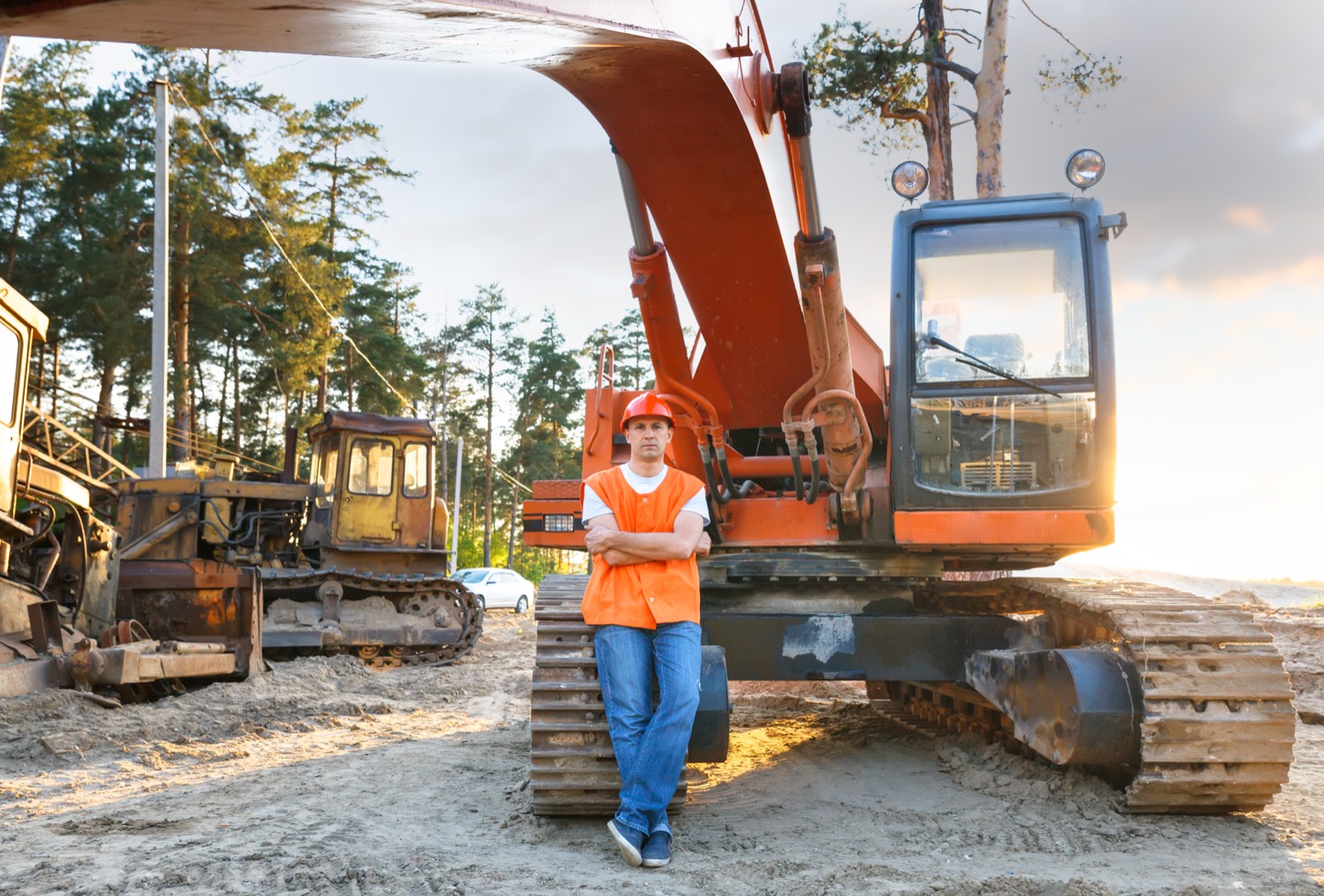
Heavy equipment operator salary
A median of $59,600 and a top 10% just short of $100,000, on a high school diploma. The interesting part is not the machine you run — it is the industry you run it in, which is worth $12,590 a year.
Highest paying outdoor jobs → Heavy equipment operator
- Median pay
- $59,600
- Range (10th–90th)
- $41,550–$100,660
- Entry
- High school diploma
- Openings a year
- 46,200
- Season
- Year-round
- Housing
- Rarely — per diem on travel
What the work actually is
Heavy equipment operators run the machines that move earth and build infrastructure — excavators, dozers, loaders, graders, cranes, pavers and pile drivers. The work is outdoors, on site, in whatever the weather is doing, and it starts early.
It is more skilled than it looks from outside. Grading to tolerance, working around buried services, and placing loads precisely are learned over years, and the difference between a competent operator and a good one is visible in the finished job. That is why the top decile earns two and a half times the bottom.
It is also a job with real hazards — heavy loads, blind spots, trenches and other trades working around your machine. Sites that take that seriously are the ones worth working for.
Pay by machine
Federal median wages within this occupation, May 2025:
Median pay by specialisation
BLS, construction equipment operators, May 2025Pay by industry — the part nobody mentions
Here is the finding worth acting on. The same operator, running the same machine, earns materially different money depending on which industry employs them.
Median pay by industry
Same occupation, different employersIf you are already in the trade and want a raise, moving from municipal work or a quarry into building or civil construction is a more reliable route than waiting for a percentage rise where you are.
Three ways in — and only one of them charges you
Entry routes compared
Union apprenticeship
Paid, no tuition- Length
- 3–4 years, varies by local
- You pay
- Nothing
- You earn
- A percentage of journeyman scale, rising each year
- Where
- IUOE locals
On the job
Paid, slower- Length
- Moderate-term on-the-job training
- You pay
- Nothing
- You earn
- Labourer wages while you learn
- Where
- Contractors — start as a labourer or oiler
Vocational school
You pay tuition- Length
- Weeks to months
- You pay
- Tuition — often four to five figures
- You earn
- Nothing during training
- Where
- Private heavy equipment schools
What the apprenticeship route typically requires
- High school diploma or equivalent, and basic maths
- Minimum age and a valid driver's licence; a CDL is often needed later
- Physical capability and a drug screen
- An application window that opens periodically — locals do not recruit continuously
Gear you actually need
Site PPE — hard hat, hi-vis to the site's class, steel toes, eye and ear protection — is generally issued or specified by your employer. Meet their standard rather than guessing.
What you provide is the everyday kit:
Work outerwear
Early starts, exposed sites, no shelter. A duck-canvas or insulated work jacket built for the site, not the slope.
Carhartt Washed Duck Active Jacket $129.99or compare alternatives →Socks
Long days in steel toes. Merino wool, cushioned, bought several pairs at a time.
Darn Tough Steely Boot work sock $26.95or compare alternatives →Hand tools
Greasing, adjusting, minor field repairs. A socket and wrench set covering metric and imperial.
Craftsman Versastack tool set $49.98or compare alternatives →Work belt
Something that survives daily use in a cab. Heavy canvas or full-grain leather.
Carhartt rugged canvas duck beltor compare alternatives →Insulated flask
You are in the cab for hours. A vacuum-insulated food jar holds a hot meal all shift.
Stanley Classic food jar $28.00or compare alternatives →Cooler
No canteen on most sites. A rotomoulded hard cooler outlasts the cheap ones by years.
YETI Roadie 24 hard cooler $250.00or compare alternatives →Where the jobs are
- IUOE locals — the apprenticeship and, for many operators, the employment route thereafter.
- General and civil contractors — the largest employers, and where the better-paying building and civil work sits.
- Municipal and state agencies — public works and highway departments. Lower cash pay, usually better pension and stability.
- Quarries, mines and pipeline work — often remote, frequently with a travel per diem.
With 46,200 openings a year, this is one of the few trades where straightforward applications to contractors still work. Persistence and a clean licence matter more than a polished CV.
Common questions
How much do heavy equipment operators make?
The median is $59,600, with the lowest 10% at $41,550 and the top 10% at $100,660 (BLS, May 2025). Pile driver operators earn a median of $70,510; paving and surfacing operators $51,650.
Do I need to go to heavy equipment school?
No. BLS lists three normal routes: on-the-job training, apprenticeship, or vocational school. The IUOE apprenticeship pays you a rising percentage of journeyman scale for three to four years and charges no tuition. A private school is a reasonable fallback if no local is accepting applications, but it should not be your first call.
Which industry pays operators the most?
Construction of buildings, at a median of $63,850, followed by heavy and civil engineering at $61,710. Local government pays least at $51,260 — a $12,590 spread for the same trade, though public employers usually offer pension and stability in exchange.
Is it hard to get hired?
Less than in most trades. The occupation employs 534,100 people and turns over roughly 46,200 positions a year, almost all replacement demand. Growth is only 4% to 2035, but openings are what determine whether you get in, and there are plenty.
Does the job include housing?
Rarely. Remote site work — pipelines, mines, large civil projects — more often pays a per diem for lodging than provides it, which is usually the better deal since you keep what you do not spend. For work that includes accommodation, see outdoor jobs that include housing.
Sources
- Wage data
- U.S. Bureau of Labor Statistics, Occupational Outlook Handbook — Construction Equipment Operators, national, May 2025. Retrieved 29 August 2026. 534,100 jobs, +4% to 2035, about 46,200 openings projected each year.
- By specialisation
- Pile driver operators $70,510 · operating engineers and other construction equipment operators $58,710 · paving, surfacing and tamping equipment operators $51,650. Same source.
- By industry
- Construction of buildings $63,850 · heavy and civil engineering construction $61,710 · specialty trade contractors $58,760 · mining, quarrying and oil and gas extraction $57,850 · local government excluding education and hospitals $51,260. Same source.
- Apprenticeship
- Roughly three to four years, varying by IUOE local, paid at a rising percentage of journeyman scale with no tuition.
- What we did not publish
- Specific apprentice wage percentages. Individual locals publish their own (one publishes 65% / 75% / 85% by year), but these are set locally and vary, so quoting one local's figures as a national standard would be wrong. Ask your local for its wage sheet.
- Corrections
- If a figure here is wrong or out of date, tell us and we will fix it and note the change.