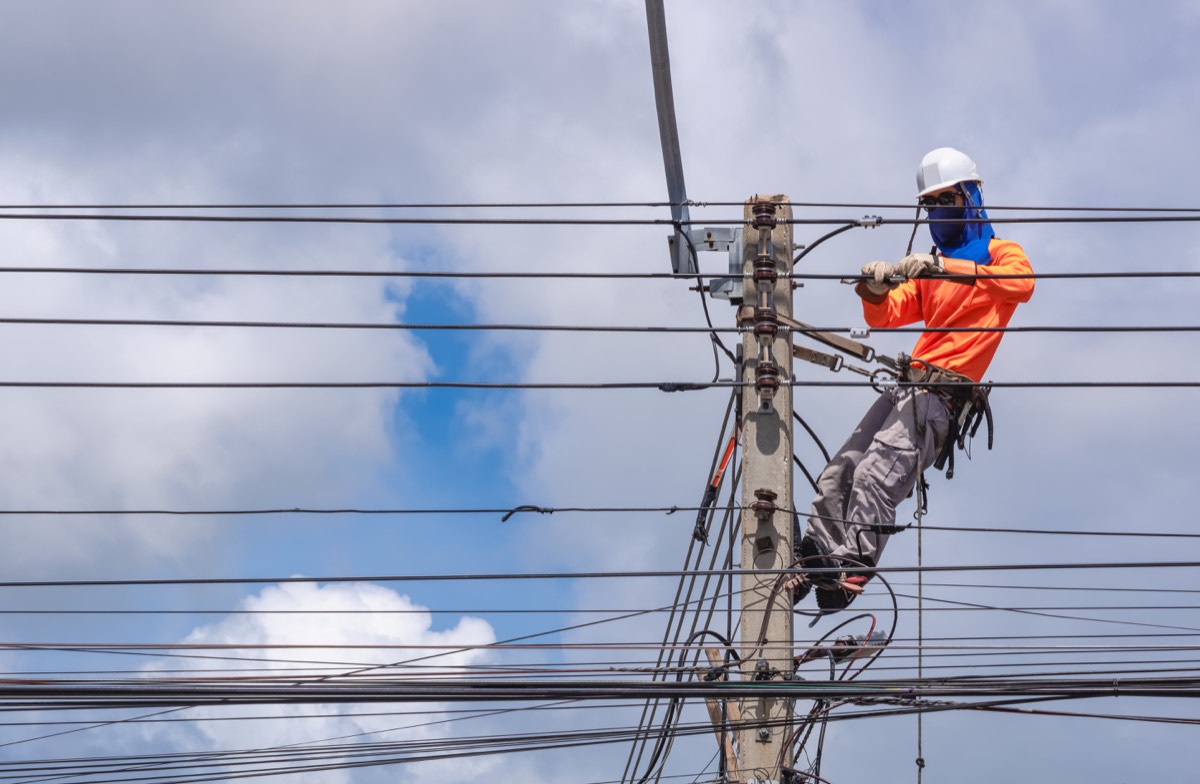
Lineman salary: what power-line workers actually earn
A median of $95,320 on a high school diploma, a top 10% above $128,000, and an apprenticeship that pays you from the first day instead of charging tuition. It is also one of the most dangerous jobs in the country.
Highest paying outdoor jobs → Lineman
- Median pay
- $95,320
- Range (10th–90th)
- $51,470–$128,690
- Entry
- High school + apprenticeship
- Tuition
- None — you are paid
- Season
- Year-round
- Housing
- Rarely — per diem on travel
What the work actually is
Linemen build and maintain the electrical distribution and transmission network — the poles, towers, conductors, transformers and substations that carry power from generation to buildings. Distribution linemen work the lower-voltage network closer to customers; transmission linemen work the high-voltage lines that cross country, often from helicopters or bucket trucks.
It is outdoor work in the sense that all of it happens outside, in whatever weather is occurring. The busiest and best-paid periods are the worst ones: after a storm takes the network down, crews work extended shifts until it is restored, frequently far from home.
It is genuinely dangerous. Line work consistently appears among the most hazardous occupations in the United States — energised conductors, height, and heavy equipment in poor conditions. Utilities and unions invest heavily in safety training because the failure modes are severe. Anyone telling you about the pay without telling you that is selling something. The pay is high in part because the risk is real.
What it pays
Federal wage data for electrical power-line installers and repairers, May 2025:
- Median: $95,320. Half earn more, half less. This is not a starting wage.
- Lowest 10%: $51,470. Broadly, apprentices and new hands.
- Top 10%: $128,690. Journeymen with specialisation, overtime, storm work, or in high-cost regions.
The $76,000 gap between the bottom and top deciles is unusually wide for a trade, and most of it is explained by three things: whether you are a journeyman, whether you are union, and whether you travel for storm restoration.
The apprentice pay ladder
Apprentice wages are set as a percentage of the journeyman rate in your local, rising in steps roughly every six months. A first-year apprentice typically starts near 50% of journeyman scale and reaches full rate on completion.
Seven steps to journeyman
Percentage of journeyman scaleHousing and travel
Line work does not come with employer housing the way seasonal park and resort jobs do. What it does come with, on travelling and storm-restoration work, is a per diem — a daily allowance for lodging and meals on top of your wage.
That is usually the better deal. A per diem is money you keep whatever you spend, and storm work is paid at overtime rates on top. It is also why the top decile is so far above the median: crews who travel earn substantially more than crews who do not.
If housing included in the job is what you need, this is the wrong trade — see outdoor jobs that include housing instead.
How to get in — and why you should not pay for it
The main route is a registered outside lineman apprenticeship, run jointly by the IBEW and NECA through the electrical training ALLIANCE (formerly the NJATC). It requires a minimum of 7,000 hours of on-the-job training and typically takes three to four years, combining paid work with classroom instruction.
Private line schools do exist and can be a legitimate route where no local is accepting applications, or as preparation to make an application competitive. They are not a shortcut, they are not required, and they cost money the apprenticeship would have paid you. Treat them as the second question, never the first.
What applications typically ask for
- High school diploma or equivalent, and usually algebra
- Minimum age, valid driver's licence, and often a CDL requirement during or after training
- Physical capability and a drug screen
- An aptitude test and interview
Application windows are set locally and can be narrow. The practical advice is the same as for seasonal federal work: find out when your local opens, and be ready before it does rather than after.
Gear you actually need
Your employer supplies the safety-critical equipment — rubber goods, arc-rated clothing to the required rating, fall protection, and the tools that must be tested and certified. Do not buy electrical PPE off a website. It has to meet the specification your employer works to and be inspected on a schedule.
What you buy yourself is the ordinary kit that makes long days outdoors bearable:
Foul-weather outer layers
You work through the weather that put the lines down. Look for a duck-canvas or insulated work jacket rated for wet cold, not a ski shell.
Carhartt Washed Duck Active Jacket $129.99or compare alternatives →Work socks
Twelve-hour days in boots. Merino wool over cotton, cushioned, and more pairs than feels sensible.
Darn Tough Steely Boot work sock $26.95or compare alternatives →Headlamp and work light
Restoration work runs into the night. Rechargeable, and rated to survive being dropped off a truck.
Black Diamond Spot 400-R headlamp $59.88or compare alternatives →Hand tools
Beyond the certified tools your employer issues, a personal set of insulated pliers, strippers and drivers.
Klein Tools 80080 hand tool kit $104.99or compare alternatives →Gear bag
Somewhere organised to keep it. A hard-bottomed tool backpack survives a jobsite far longer than a soft tote.
Klein Tradesman Pro tool backpack $119.99or compare alternatives →Work belt
Something that survives daily use under a tool belt. Heavy canvas or full-grain leather.
Carhartt rugged canvas duck beltor compare alternatives →Where the jobs are
- IBEW locals — the apprenticeship route and, for many, the employment route thereafter. Start here.
- Utilities directly — investor-owned utilities, municipal utilities and rural electric cooperatives all hire linemen and apprentices on their own career pages.
- Line contractors — the firms utilities hire for construction and storm restoration. This is where most travelling work sits.
- Storm rosters — contractors maintain call lists for restoration work. Getting on one is how experienced hands access the highest-earning weeks of the year.
General job boards are the weakest route for this trade. Line work is filled through locals, utility career pages and contractor relationships far more than through advertised vacancies.
Common questions
How much does a lineman make?
The median is $95,320 a year, with the lowest 10% at $51,470 and the top 10% above $128,690 (BLS, May 2025). Apprentices start near 50% of the journeyman rate in their local and step up roughly every six months over three to four years.
Do I need a degree to be a lineman?
No. Typical entry is a high school diploma followed by a registered apprenticeship. It is one of the highest-paying jobs in the country available without a degree, and it outearns most degree-required outdoor occupations.
Do I have to pay for lineman school?
Not for the main route. A registered IBEW/NECA outside lineman apprenticeship pays you while you train — a minimum of 7,000 hours over three to four years. Private line schools charge tuition and are optional; check whether your local is accepting applications before paying anyone.
Why is the pay range so wide?
Three factors: apprentice versus journeyman, union versus non-union, and whether you travel. Storm restoration is paid at overtime rates with a per diem on top, which is how the top decile gets so far above the median.
Is being a lineman dangerous?
Yes. It is consistently among the most hazardous occupations in the United States — energised conductors, working at height, and heavy equipment in bad weather. The training and safety culture exist because the consequences of error are severe. This is a real part of the job, not a footnote.
Sources
- Wage data
- U.S. Bureau of Labor Statistics, Occupational Outlook Handbook — Electrical Power-Line Installers and Repairers, national, May 2025. Retrieved 29 August 2026.
- Employment outlook
- 131,900 jobs, projected +7% to 2035 (faster than average).
- Apprenticeship
- Minimum 7,000 on-the-job hours, three to four years, seven wage steps advancing roughly every six months, starting near 50% of journeyman scale. Source: electrical training ALLIANCE (formerly NJATC), a joint IBEW/NECA programme.
- What we did not publish
- The exact percentage at each intermediate apprentice step, because it is set locally and varies. The chart shows the shape of the progression, not published national figures.
- Corrections
- If a figure here is wrong or out of date, tell us and we will fix it and note the change.