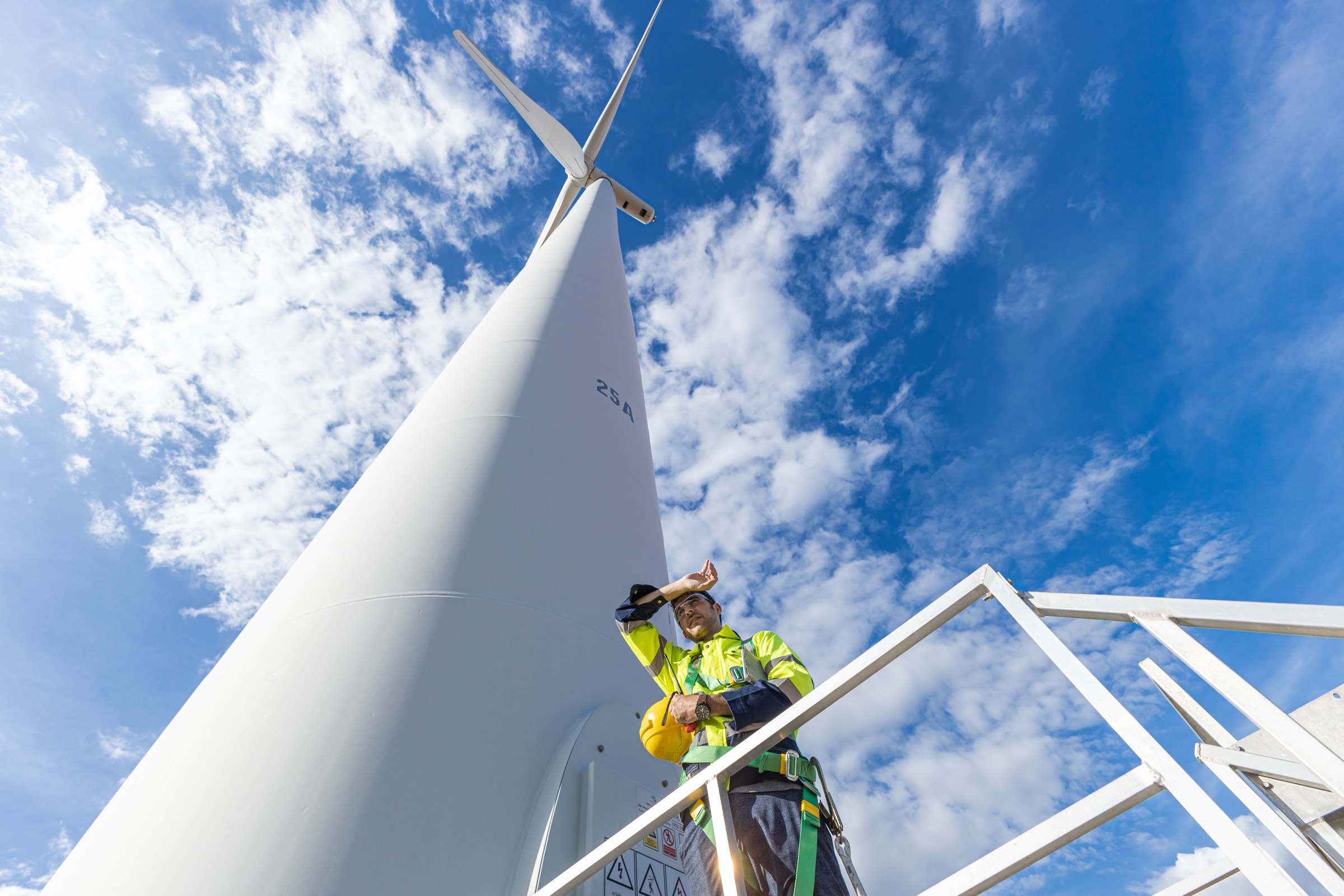
Wind turbine technician salary
A median of $64,120, entered on a short certificate rather than a degree — and the most striking number is not the median. It is the floor: even the bottom 10% earn $49,230.
Highest paying outdoor jobs → Wind turbine technician
- Median pay
- $64,120
- Range (10th–90th)
- $49,230–$92,460
- Entry
- Postsecondary certificate
- Growth to 2035
- +30%
- Season
- Year-round
- Housing
- No — per diem on travel
How tight the range is
Compare the spread with two other trades on this site. A narrow band means the job pays what it pays regardless of where you land; a wide one means your employer, location and specialisation decide.
10th to 90th percentile
All bars on the same $0–$130k scaleWhat the work actually is
Wind turbine service technicians — windtechs — install, maintain and repair turbines. That means climbing the tower, working inside the nacelle at the top, and troubleshooting mechanical, hydraulic and electrical systems a long way above the ground.
BLS describes the work environment plainly: outdoors, in confined spaces, and often at great heights. Most windtechs work full time and may be on call evenings and weekends, because a stopped turbine is not earning.
If you are uneasy with heights, this is not a job you can grow into. Climbing 250 feet inside a tower to work in a space the size of a van is the job, every day, not an occasional part of it. That single trait filters more people out of this trade than any qualification does.
Offshore work is a distinct and growing branch — better paid, harder access, and rotational rather than daily.
The growth figure, in context
Wind turbine technician is projected to grow 30% between 2024 and 2035, among the fastest of any occupation in the United States.
The practical implication: this is a trade worth entering, but do not assume the growth rate means easy hiring. Positions cluster around wind resource — the Plains, Texas, and increasingly offshore on the Atlantic coast — and being willing to move is most of the job search.
How to get in
Entry is a postsecondary nondegree award — a certificate from a technical college, typically taken over months rather than years — followed by long-term on-the-job training. It is not a degree, and it is not an apprenticeship in the union sense.
- Technical college wind programs are the main route. Community and technical colleges in wind regions run them, and costs vary considerably.
- Manufacturer and operator training. Turbine manufacturers and operations companies run their own schemes, and some hire and train directly — the best-value route where available. Ask employers what they hire from before enrolling anywhere.
- Safety and rescue certification — climb, tower rescue and first aid — is required, and employers commonly arrange it.
- The physical bar is real: weight limits for climbing equipment, ability to climb the tower carrying tools, and comfort at height.
Gear you actually need
Climbing harness, fall arrest, helmet and the tower rescue kit are life-safety equipment supplied and inspected by your employer to a specification. Never source that yourself.
What you buy is what makes a day up a tower tolerable:
Layers
A nacelle is cold in winter and an oven in summer, and you cannot easily go back down. Merino base layers regulate across both.
Merino wool base layer top $44.99or compare alternatives →Socks
Long days, climbing, boots you do not take off. Merino wool, cushioned, several pairs.
Darn Tough Steely Boot work sock $26.95or compare alternatives →Headlamp
Nacelle interiors are dark and your hands are busy. Rechargeable, and tough enough to drop down a tower.
Black Diamond Spot 400-R headlamp $59.88or compare alternatives →Insulated flask
There is no coming down for a coffee. A vacuum-insulated food jar is the standard answer.
Stanley Classic food jar $28.00or compare alternatives →Where the jobs are
- Turbine manufacturers — Vestas, GE Vernova, Siemens Gamesa and others service their own fleets and are among the largest employers of windtechs.
- Independent service providers — third-party maintenance contractors, often the route into travelling work with a per diem.
- Wind farm owners and operators — utilities and independent power producers running their own sites.
- Offshore developers — a smaller but expanding branch on the Atlantic coast, with rotational schedules closer to offshore oil work.
Common questions
How much do wind turbine technicians make?
The median is $64,120, with the lowest 10% at $49,230 and the top 10% at $92,460 (BLS, May 2025). The floor is unusually high — the bottom decile earns more than the median for several other outdoor occupations.
Do I need a degree to be a wind turbine technician?
No. Entry is a postsecondary nondegree award — a technical certificate typically taken over months — plus long-term on-the-job training. No bachelor's degree is required.
Is wind turbine technician really the fastest-growing job?
It is among the fastest by percentage, at 30% growth to 2035. But it employs only 11,800 people, so that is roughly 6,800 additional jobs over a decade. Occupations with lower growth rates and much larger workforces often offer more actual openings.
Is it dangerous?
The work is at height, in confined spaces, on mechanical and electrical systems. Fall protection and rescue training are mandatory and taken seriously. The genuine filter is comfort with heights — climbing the tower is the job, not an occasional part of it.
Does it include housing?
No. Travelling and contract work usually pays a per diem for lodging rather than providing it, which is generally the better deal. For work that includes accommodation, see outdoor jobs that include housing.
Sources
- Wage data
- U.S. Bureau of Labor Statistics, Occupational Outlook Handbook — Wind Turbine Technicians, national, May 2025. Median $64,120; 10th percentile $49,230; 90th percentile $92,460. Retrieved 29 August 2026.
- Employment
- 11,800 jobs in 2024, projected +30% (about 6,800 additional jobs) to 2035.
- Comparison bars
- Heavy equipment operator and oil and gas worker percentiles from the same source and date, plotted on a common $0–$130,000 scale.
- What we did not publish
- An offshore pay premium, or typical technical college tuition. Neither is published as a national figure, and both vary enough that a single number would mislead.
- Corrections
- If a figure here is wrong or out of date, tell us and we will fix it and note the change.